A simple overall practice plan that fits real life
The best practice plan is the one you’ll actually do. This page gives a straightforward routine for beginner players to improve their blunders awareness, tactics ability, openings repertoire, and endgame understanding. For details on each part, click the links below.
The daily plan (30 minutes)
- 10 minutes tactics (one theme: forks, pins, hanging pieces)
- 15 minutes play (rapid is better than blitz for learning)
- 5 minutes review (find the one moment you missed a tactic or hung a piece)
The 30-Minute Daily Chess Improvement Plan
- Play a couple of games. Look at 3–5 positions
- Ask: "What is hanging?"
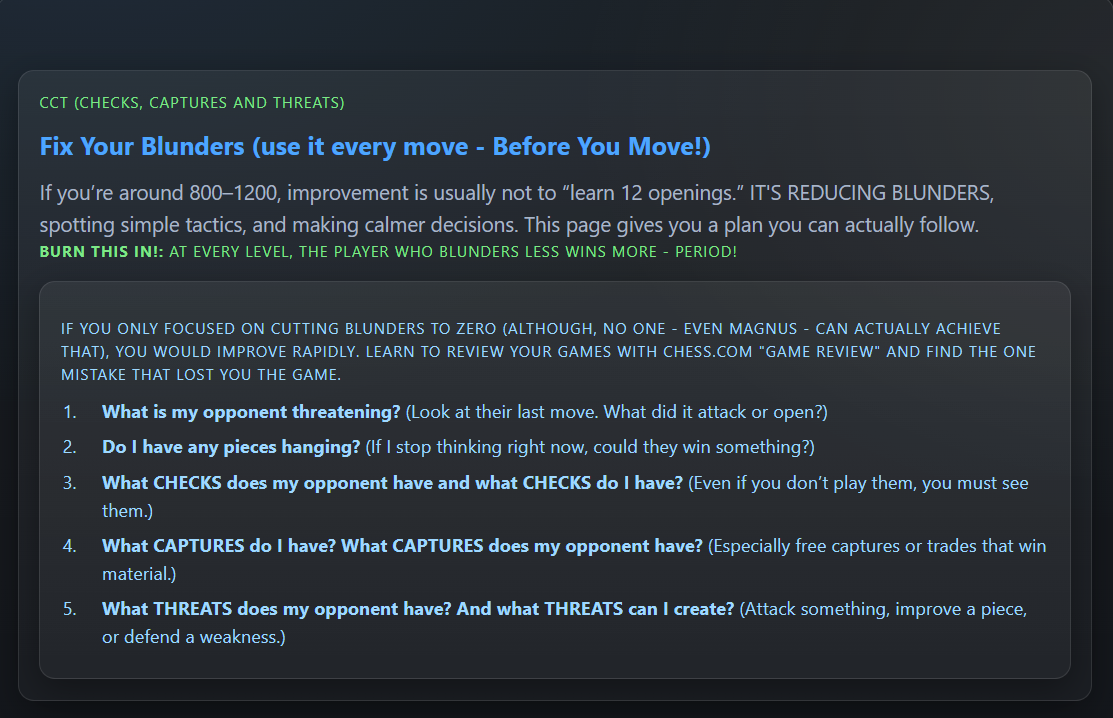
- Run quick CCT scan
- Focus: Don’t miss obvious mistakes
- Solve 5–10 puzzles slowly
- Use CCT before every answer
- Name the pattern (fork, pin, etc.)
- Focus: Pattern recognition
- Play rapid or blitz (not bullet)- Even 15/10 games once in a while - (more time to think CCT)
- Use CCT before every move - Don't move too fast!
- Don’t rush — avoid giveaways. Don't worry about your rating - at least at first!
- Focus: Apply what you practiced
- Find 1 mistake you made
- Ask: "Why did I miss it?"
- Identify pattern (blunder, tactic, etc.)
- Focus: Learn one lesson per day
The weekly plan (2 small upgrades)
Play one slower game per week (or a couple of 15|10 games). Slower games reveal your real thinking errors.
- Use your “Before You Move” checklist from Learn.
- Don’t guess. If you’re unsure, check threats and hanging pieces first.
Review 2–3 losses and label the mistake type. Patterns are the point.
- Hanging piece
- Ignored threat
- Missed fork/pin/skewer
- King safety
Keep a tiny notebook with your top 3 recurring mistakes. Read it before you play.
- This takes 30 seconds
- It works because it changes your attention
How to use tactics training correctly
Tactics training is only useful if you build pattern recognition. The goal is not to solve 200 puzzles quickly. The goal is to learn what forks and pins feel like on the board.
- Solve slowly: look for checks, captures, threats.
- Don’t guess: if you guess, you don’t train calculation.
- Repeat themes: one week forks, one week pins, etc.
When to study openings (and when not to)
If you are still hanging pieces regularly, opening study won’t help much. Here’s a sensible timeline:
- First: learn opening principles and develop pieces reliably.
- Next: learn one simple opening setup for white and one for black.
- Later: add deeper opening study after your blunders drop.