Lean Mean Beginner Plan
A stripped-down chess plan for true beginners who want a clear order of attack, fewer distractions, and a simple path to real improvement.
This page is for the student who does not want twenty doors, fifty side quests, and a parade of shiny objects. It is a practical starting path: learn the essentials, ignore the fluff, and build habits that actually show up in real games.
This plan is for you if...
- You are brand new to chess or coming back after a very long break.
- You want someone to say, “Start here. Then do this next.”
- You improve better with structure than with endless browsing.
- You want to stop feeling lost every time you try to study.
This plan is not for you if...
- You already have a solid study routine and know what you need.
- You want to jump around freely from topic to topic.
- You are already beyond the true beginner stage and do not want a reset.
- You enjoy exploring many lines before building the basics.
Beginners improve faster when they stop trying to carry the whole chess universe in a paper sack.
- Deep opening memorization
- Fancy traps and “gotcha” lines
- Obscure gambits
- Advanced endgame theory
- Wild sacrifices you do not understand
- Playing too fast just because blitz looks exciting
Learn the battlefield
Before strategy, before tactics, before opening talk, make sure the foundation is solid. You should know how the board works, how each piece moves, what check means, and what checkmate means.
- Learn board coordinates and starting setup.
- Learn how each piece moves.
- Understand check, checkmate, and stalemate.
- Make sure you can spot basic legal and illegal moves.
Survive the opening
The goal is not to become an opening encyclopedia. Since this is the "Lean, Mean", I suggest you start with the "Stonewall" opening system. It is easy to learn, gives you a solid structure, and lets you focus on tactics and strategy without getting lost in move memorization.
- Fight for the center.
- Develop your pieces.
- Get your king safe.
- Do not move the same piece over and over without a reason.
- Do not grab random pawns and hope the chess gods smile upon it.
Stop hanging pieces
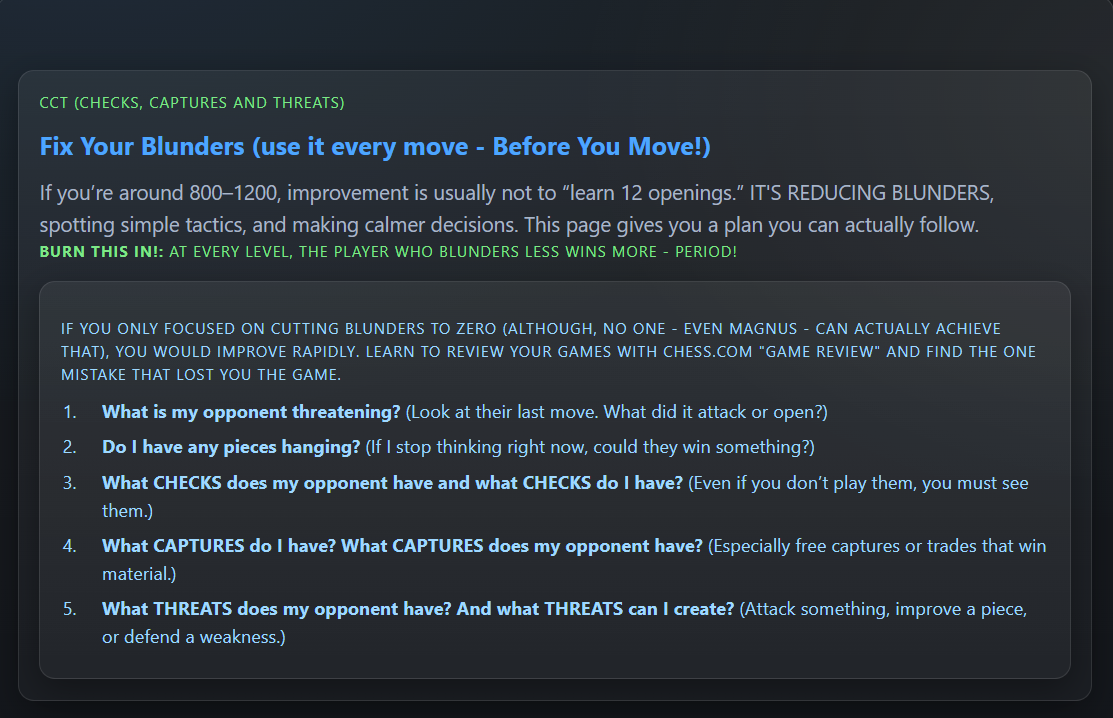
Most beginner games are decided by blunders, not brilliance. Your first superpower is learning how to reduce simple mistakes.
- Use a short safety check before every move.
- Practice CCT: Checks, Captures, Threats.
- Ask: “What changed after my opponent’s last move?”
- Ask: “If I play this move, what can my opponent do next?”
Learn your first three tactics
You do not need a giant tactics warehouse on day one. Start with a small toolkit you will actually recognize in real games.
- Forks
- Pins
- Skewers
- Practice spotting them before worrying about harder themes.
Play slow games and review them
Improvement happens when you play, make mistakes, notice them, and try again with slightly better habits.
- Play slower games when possible. 15/10 on Chess.com. Gives you time to think.
- After the game, look for one or two turning points.
- Ask where the first serious mistake happened.
- Do not review like a machine. Review like a student looking for lessons.
Week 1
- Watch 2 opening videos.
- Watch 2 blunder-prevention videos.
- Play 3 slow games.
- After each game, write down one mistake you noticed.
- Before every move, practice CCT.
Week 2
- Watch 2 tactics videos.
- Focus on forks, pins, and skewers only.
- Play 3 more slow games.
- Review at least 1 game carefully.
- Keep using the same opening principles and blunder checks.
That is enough. Really. You do not need twelve books, six coaches, and a sacred mountain cave. You need repetition, clarity, and patience.
If you are a true beginner, resist the urge to constantly switch systems. Follow one simple path long enough to let it work. The basics are not boring. They are the bricks everything else stands on.